



TECHNOLOGY
Operating precautions for MechaTrans®
Storage temperature and humidity
- Store MechaTrans® between -5 and +40 ℃ at 40 %RH or less.
- Using MechaTrans® above 70 per cent relative humidity with a constant voltage applied causes migration at the internal electrodes of the piezoelectric actuator and can degrade the insulation resistance.
- The operating temperature range is -20 to 85 ℃. Allow for the temperature rise of the actuator itself in any application.
Handling and mounting
4. Keep tension off the piezoelectric actuator
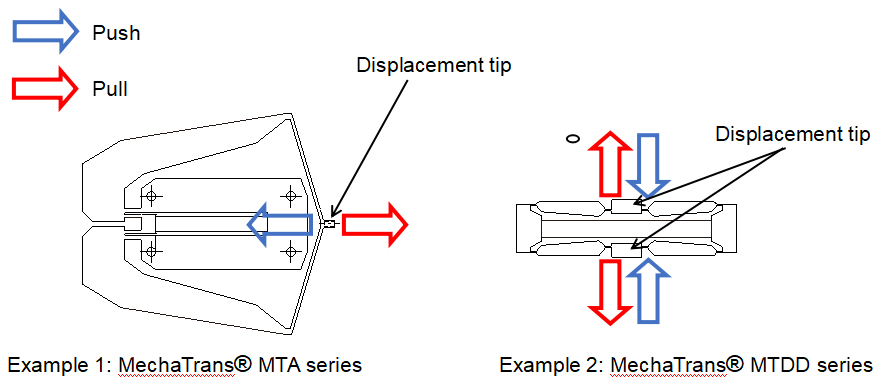
- When connecting MechaTrans® to another mechanism, do not mount it in the same direction as the displacement.
- Do not push, pull or twist the tip of the displacement part.
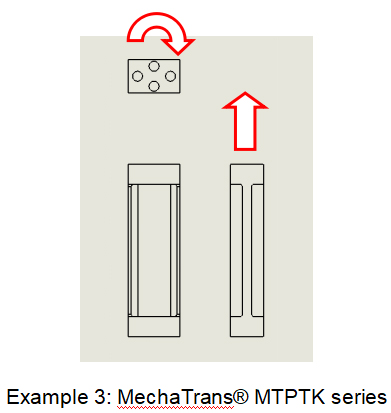
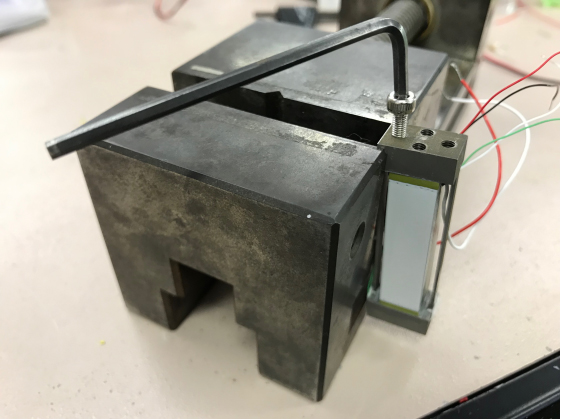
On the MTPTK series, hold the upper part of the actuator as shown below so that the screw tightening force cannot twist the unit.
The piezoelectric actuator inside MechaTrans® is ceramic. Ceramic is weak in tension and will break if pulled hard enough. MechaTrans® turns the displacement and force of the actuator into a much larger displacement and force, and the relationship runs both ways: force applied at the displacement tip reaches the actuator multiplied. If that force pulls the actuator, it will destroy it. The pulling direction is opposite to the direction of displacement, so never apply force that way.
5. Use the correct screw length
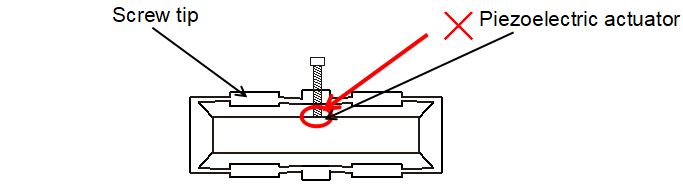
Use screws of the length shown below. A screw that is too long can touch the piezoelectric actuator, and a scratch is enough to destroy it. Applies to the MTDD, MTD, MTKK and MTK series.
6. Stop the unit rotating while you tighten
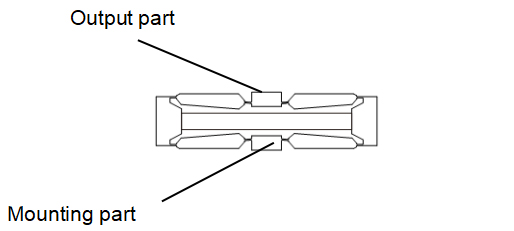
When fastening the mounting part of MechaTrans® to a base, hold it with a jig or tool so that it cannot rotate. Do the same for the output part when attaching a load. The rotating moment produced while tightening a screw can otherwise damage the unit. Applies to the MTDD, MTD, MTKK and MTK series.
Applying voltage
7. Stay within the rated voltage. Exceed it and the piezoelectric actuator inside MechaTrans® may be damaged, which the warranty does not cover.
8. Avoid short circuits
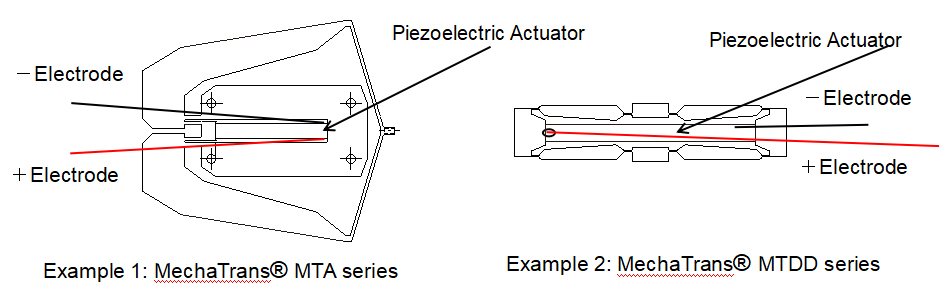
A high voltage sits between the electrodes of the piezoelectric actuator while MechaTrans® is running. Keep wires, liquids and conductive material away from the electrodes.
9. Applying a large voltage instantaneously
When a DC voltage is switched directly onto MechaTrans®, note the following.
- Fit a resistor between the supply and MechaTrans®.
- Limit the inrush current to prevent mechanical damage to the actuator, particularly with a square wave drive.
- Switching DC directly on with no series resistor can produce twice the static displacement and damage the unit. Add a suitable resistor, raise the voltage gradually, or keep it below 80 V.
10. Observe the lead wire polarity
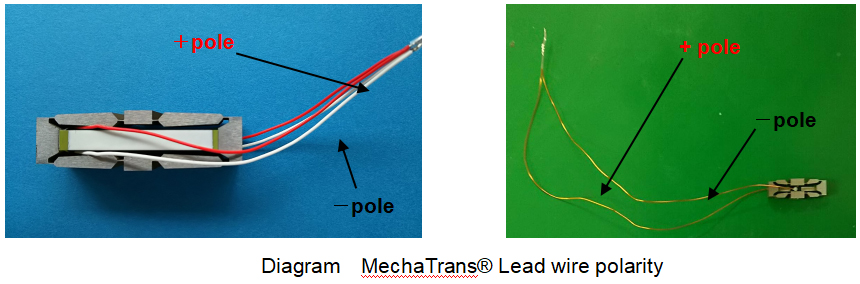
Red is positive and white, or black, is negative. On models where the colour does not distinguish them, the longer lead is positive. The MTDD03S50F3 and MTD03S50F3 are examples.
Reverse the polarity and the displacement goes negative up to about -20 V, then swings back positive above that. This comes from polarization inversion inside the actuator, and continued reverse drive will break it. Use one polarity only.
Characteristics of MechaTrans®
11. Hysteresis
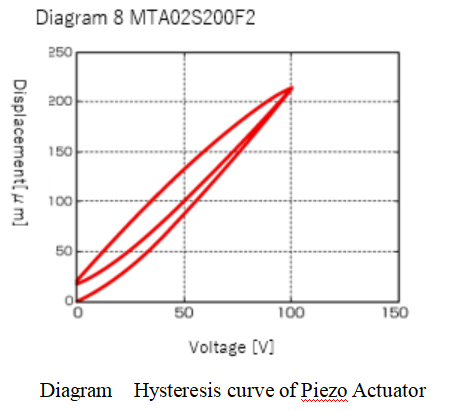
For the same applied voltage, the displacement differs slightly between a rising and a falling voltage. This is inherent to the piezoelectric actuator and cannot be designed out. If you need to control the absolute displacement, a displacement sensor is essential.
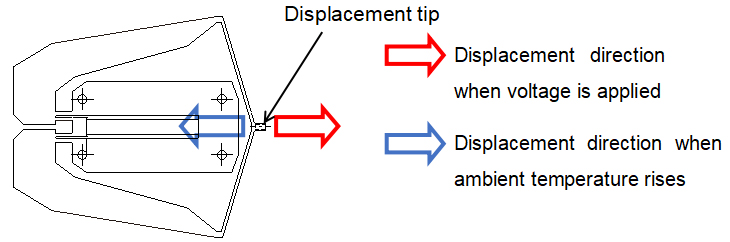
12. Temperature drift
The initial position of the displacement tip shifts as the ambient temperature changes. The example below shows the direction of that shift as the temperature rises. Measurements can be taken to compensate for it, so please ask if you need to.
Storage, disassembly and warranty
- Do not disassemble MechaTrans®. We cannot repair a unit that has been taken apart.
- When MechaTrans® is not in use, keep it somewhere dry, a desiccator for example, at 40 per cent humidity or less. Applying a voltage to an actuator that has absorbed moisture can cause migration and damage it. Short the electrodes together during storage so that charge does not build up.
- Stored and used properly, we guarantee the performance of MechaTrans® for one year or 10 million cycles from the date of purchase. Contact us if you need a longer guarantee. Some models in our records have passed 15 billion cycles.
Unsure about a mounting or drive detail?
Send us a sketch of how you plan to mount and drive the actuator and we will check it before you build.
CONTACT US →