



TECHNOLOGY
Actuator (piezoelectric element)
About the piezoelectric effect
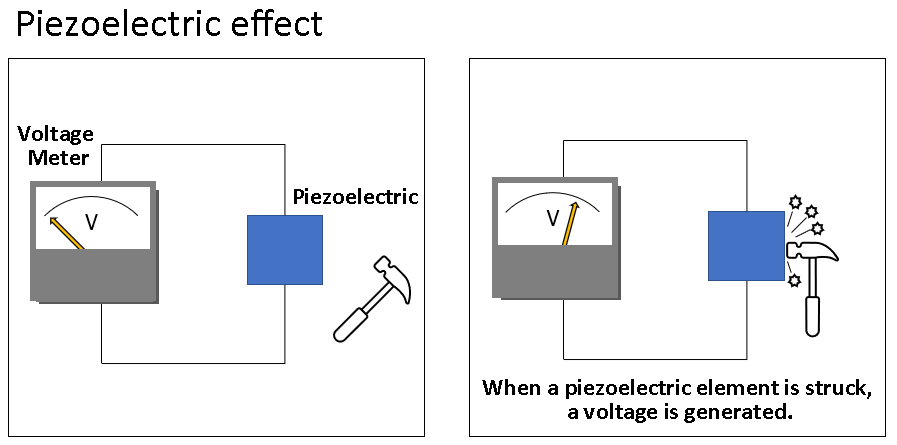
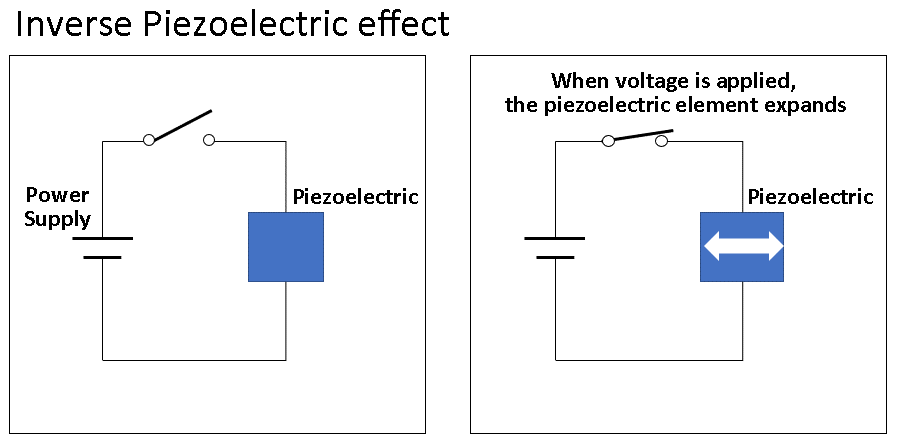
A piezoelectric element generates an electric charge or field when force is applied to it. Apply a voltage instead and it displaces and generates force, which is the inverse piezoelectric effect. In short, the piezoelectric effect converts mechanical energy into electrical energy, and the term is often used loosely to cover the inverse effect as well.
The effect is also called the piezo effect. The word piezo comes from the Greek piezein, meaning to push or to press.
Jacques and Pierre Curie, the French physicist brothers, discovered the effect in 1880. Pierre later shared the Nobel Prize in Physics with his wife, Marie Curie, the first woman to win one.
You will find piezoelectric elements in everyday ignition devices such as lighters. Pressing the switch makes an internal part strike the element, and the resulting spark lights the gas.
Where it is used
Quartz crystal was the original material. Research since then has produced far more efficient ones, and today most elements are made of piezoelectric ceramic, a highly dielectric ceramic polarised by applying a high voltage.
The direct effect, turning force or vibration into electricity, is used in acceleration sensors, force sensors, vibration gyro sensors and ultrasonic diagnostic equipment. It is also being studied for power generation, such as floor systems that light LEDs when stepped on.
The inverse effect, turning electricity into mechanical force, is the driving source behind high performance piezo actuators. The elements offer high resolution, high speed operation, small size with large generating force, and good energy efficiency.

Elements come in several forms. A single plate element is one layer; a multilayer element has many internal electrodes fired simultaneously inside the piezoelectric material so that it can be driven at low voltage. Stacking the material in layers lifts the displacement well beyond what a single plate can manage, which opens up applications the single plate cannot serve.
Characteristics to design around
Small displacement
A piezoelectric element expands smoothly with the applied voltage, but only by about 0.1 per cent of its length. A 40 mm element in the stacking direction moves roughly 40 to 50 µm, less than the thickness of a single hair, which limits where it can be used on its own. Our displacement magnification mechanism uses the lever principle to multiply that movement several to several tens of times. MechaTrans combines the element with that mechanism, and the direction of displacement can be changed to suit the application.
Hysteresis
The displacement follows a different path on the way up from zero to maximum voltage than on the way down, a behaviour known as hysteresis. The same voltage therefore does not always give the same absolute position, and the error is around 15 per cent of the maximum displacement. Piezo actuators inherit this, so they do not repeat a position exactly under the same voltage. Adding a displacement sensor and feeding its signal back to adjust the voltage, that is, closed loop control, gives stable drive with high repeatability and positioning down to nanometre units. Control without feedback is called open loop; it is less precise but simpler and cheaper to build. Our Piezo Assist Stage runs inexpensively in open loop, or with a PID closed loop for stable positioning in 15 nm steps.
Temperature and creep
A piezoelectric element expands and contracts with temperature, and holding a constant voltage causes creep, where the displacement grows slowly over time. Open loop control cannot correct these small drifts, but closed loop control can.
Sensitive to heat and humidity
At room temperature and below 40 per cent humidity, an element will run almost indefinitely. In a hot, humid environment, 90 per cent humidity for example, it can fail within weeks. This applies to DC drive; durability improves under frequent on and off drive, that is, full voltage and zero voltage.
We have more than 20 years of design and application experience behind us, so please get in touch about the right design, drive method and handling for your case.
Talk it through with us
Tell us what you are driving and how, and we will suggest an element, an actuator and a control approach that suit it.
CONTACT US →